Report on the efficacy of Glucoraphanin and its active metabolite radisin

2025-12-15 Visits:

I. Introduction 

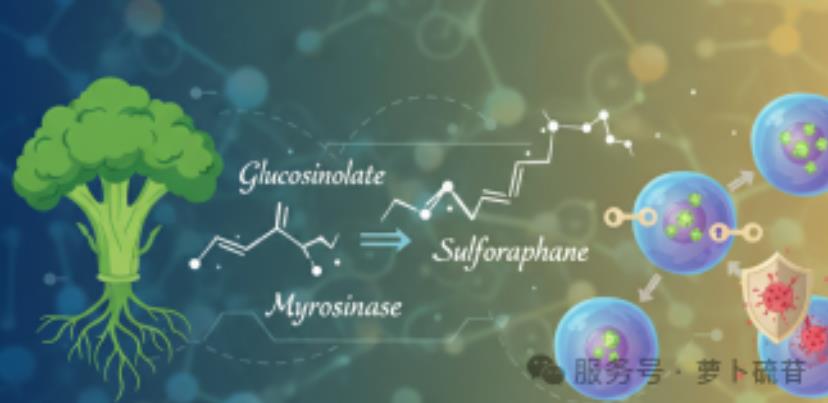
 Glucoraphanin (GR) is a thioglucoside naturally found in cruciferous vegetables, especially broccoli seeds and sprouts. It is itself a biologically active proctor, which is hydrolyzed into sulforaphane (SFN) with strong biological activity under the action of Myrosinase. In recent years, radiss has become a research hotspot in the field of biomedicine because of its wide pharmacological activity and good safety. This report aims to summarize the efficacy and clinical research progress of radiculine in anti-tumor, antioxidant, anti-inflammatory and neurological protection. II. Core pharmacological activity and mechanism of action.
8888888888888888888.png

 The various biological activities of radic acid (SFN) mainly come from its powerful chemical protective effect. The core mechanisms include: activating the Nrf2 signaling pathway: radic acid is an effective activator of nuclear factor E2 correlation factor 2 (Nrf2). Nrf2 is a key regulatory factor in intracellular resistance to oxidative stress. After activation, it can upregulate the expression of a variety of detoxification enzymes (such as glutathione S-transferase, quinone oxidoreductase, etc.) and antioxidant proteins, thus protecting cells from free radicals and environmental toxins. Regulate the inflammatory pathway: Radic acid can inhibit the production of inflammatory factors by regulating signaling pathways such as NF-κB and exert a strong anti-inflammatory effect.

III. Main curative effect and research progress 

 1. 🎯 Anticancer Effects 

 The anti-tumor effect of sulfurine is one of its most concerned effects, showing the prevention and treatment potential for a variety of cancers (such as lung cancer, prostate cancer, breast cancer, bladder cancer, pancreatic cancer, etc.). Inhibition of tumor progression: by regulating gene expression, inducing apoptosis, inhibiting cell proliferation and migration. Targeted cancer stem cells (CSC): Research shows that SFN can target cancer stem cells of different cancer types, which is essential for preventing tumor metastasis and recurrence. 

 Chemical sensitizer: SFN can be combined with common clinical anti-cancer drugs (such as cisplatin, paclitaxel, etc.) to enhance the drug sensitivity of cancer cells, reduce drug resistance, and reduce the side effects of radiotherapy. Cancer chemical prevention: Clinical trials (such as research conducted in Qidong, China) have confirmed that preparations rich in radish thioside/radish thioside can accelerate the detoxification and excretion of potential carcinogens (such as air pollutants benzene, acryl and aflatoxin) and reduce their related long-term health risks. 

 2. 🧠 Neuroprotection & Mental Health 

 Because SFN can pass through the blood-brain barrier, its antioxidant and anti-inflammatory properties are widely used in the study of neurological diseases. Improve cognitive function: SFN activates Nrf2 to protect nerve cells from oxidative pressure. Neurodegenerative.

3. 🛡️ Other Potential Benefits 

 Anti-inflammatory: Regulate the NF-κB or Nrf2 pathway, which is used to prevent neurodegenerative diseases, stroke and enteritis, etc. Metabolic diseases: have the potential to improve inflammatory chronic diseases, such as reducing the concentration of insulin levels in patients with type 2 diabetes. Reduce the body fat content of obese patients. Cardiovascular disease: Prevent cardiovascular disease by activating vascular endothelial cells and regulating the proliferation of vascular smooth muscle cells. 
360截图20251215102119440.jpg

 IV. Safety and preparation development 

 1. Security 

 Many studies have shown that preparations with a long-term oral dose range of 9~36mg SFN in the human body have good tolerance and no obvious adverse reactions. A few side effects reported include constipation, nausea and intestinal gas bloating. This shows that SFN has the potential to develop into a functional food or clinical drug. 2. Development of preparations 

 Because the efficiency of converting radish thioside into active radish thion is affected by many factors, researchers are developing new compositions to improve bioavailability. For example, the combination of radish thioside with functional oligosaccharide can significantly improve the conversion rate of radish thioside to radish thion in the intestine, thus enhancing its efficacy. V. Conclusion and Outlook 

 The active metabolite of radish thioside (SFN), is a natural compound with broad-spectrum pharmacological activity, which has great application potential in many fields such as anti-cancer, anti-inflammatory, antioxidant and nerve protection. With the promotion of more clinical trials

With the development of new high-conversion-rate preparations, sulfurified radish is expected to become an important natural drug or functional food ingredient for cancer chemical prevention, adjuvant treatment and a variety of chronic disease intervention.

Leave Your Message


Leave a message

We use cookie to improve your online experience. By continuing to browse this website, you agree to our use of cookie.

Cookies

Please read our Terms and Conditions and this Policy before accessing or using our Services. If you cannot agree with this Policy or the Terms and Conditions, please do not access or use our Services. If you are located in a jurisdiction outside the European Economic Area, by using our Services, you accept the Terms and Conditions and accept our privacy practices described in this Policy.
We may modify this Policy at any time, without prior notice, and changes may apply to any Personal Information we already hold about you, as well as any new Personal Information collected after the Policy is modified. If we make changes, we will notify you by revising the date at the top of this Policy. We will provide you with advanced notice if we make any material changes to how we collect, use or disclose your Personal Information that impact your rights under this Policy. If you are located in a jurisdiction other than the European Economic Area, the United Kingdom or Switzerland (collectively “European Countries”), your continued access or use of our Services after receiving the notice of changes, constitutes your acknowledgement that you accept the updated Policy. In addition, we may provide you with real time disclosures or additional information about the Personal Information handling practices of specific parts of our Services. Such notices may supplement this Policy or provide you with additional choices about how we process your Personal Information.


Cookies

Cookies are small text files stored on your device when you access most Websites on the internet or open certain emails. Among other things, Cookies allow a Website to recognize your device and remember if you've been to the Website before. Examples of information collected by Cookies include your browser type and the address of the Website from which you arrived at our Website as well as IP address and clickstream behavior (that is the pages you view and the links you click).We use the term cookie to refer to Cookies and technologies that perform a similar function to Cookies (e.g., tags, pixels, web beacons, etc.). Cookies can be read by the originating Website on each subsequent visit and by any other Website that recognizes the cookie. The Website uses Cookies in order to make the Website easier to use, to support a better user experience, including the provision of information and functionality to you, as well as to provide us with information about how the Website is used so that we can make sure it is as up to date, relevant, and error free as we can. Cookies on the Website We use Cookies to personalize your experience when you visit the Site, uniquely identify your computer for security purposes, and enable us and our third-party service providers to serve ads on our behalf across the internet.

We classify Cookies in the following categories:
 ●  Strictly Necessary Cookies
 ●  Performance Cookies
 ●  Functional Cookies
 ●  Targeting Cookies


Cookie List
A cookie is a small piece of data (text file) that a website – when visited by a user – asks your browser to store on your device in order to remember information about you, such as your language preference or login information. Those cookies are set by us and called first-party cookies. We also use third-party cookies – which are cookies from a domain different than the domain of the website you are visiting – for our advertising and marketing efforts. More specifically, we use cookies and other tracking technologies for the following purposes:

Strictly Necessary Cookies
These cookies are necessary for the website to function and cannot be switched off in our systems. They are usually only set in response to actions made by you which amount to a request for services, such as setting your privacy preferences, logging in or filling in forms. You can set your browser to block or alert you about these cookies, but some parts of the site will not then work. These cookies do not store any personally identifiable information.

Functional Cookies
These cookies enable the website to provide enhanced functionality and personalisation. They may be set by us or by third party providers whose services we have added to our pages. If you do not allow these cookies then some or all of these services may not function properly.

Performance Cookies
These cookies allow us to count visits and traffic sources so we can measure and improve the performance of our site. They help us to know which pages are the most and least popular and see how visitors move around the site. All information these cookies collect is aggregated and therefore anonymous. If you do not allow these cookies we will not know when you have visited our site, and will not be able to monitor its performance.

Targeting Cookies
These cookies may be set through our site by our advertising partners. They may be used by those companies to build a profile of your interests and show you relevant adverts on other sites. They do not store directly personal information, but are based on uniquely identifying your browser and internet device. If you do not allow these cookies, you will experience less targeted advertising.

How To Turn Off Cookies
You can choose to restrict or block Cookies through your browser settings at any time. Please note that certain Cookies may be set as soon as you visit the Website, but you can remove them using your browser settings. However, please be aware that restricting or blocking Cookies set on the Website may impact the functionality or performance of the Website or prevent you from using certain services provided through the Website. It will also affect our ability to update the Website to cater for user preferences and improve performance. Cookies within Mobile Applications

We only use Strictly Necessary Cookies on our mobile applications. These Cookies are critical to the functionality of our applications, so if you block or delete these Cookies you may not be able to use the application. These Cookies are not shared with any other application on your mobile device. We never use the Cookies from the mobile application to store personal information about you.

If you have questions or concerns regarding any information in this Privacy Policy, please contact us by email at . You can also contact us via our customer service at our Site.